


I’ll readily admit that I went down an AI rabbit hole that sent me around and around in circles a couple of weeks back.
It’s been years since I’ve written with any real consistency or created on a frequent schedule. My podcast was a regular commitment back in the day, which is exactly why I know that creation is like a muscle: the more frequently you train and the more reps you get in, the easier it gets.
Well what I can tell you is - my creation muscles have atrophied, big time.
And since the last time I actually was using this creative brain of mine consistently (looking back at my recordings, it really was pre-COVID, so let’s give or take 7 years), the world has changed in quite a curious way. We now have these phenomenal artificial intelligence tools that can do a lot of knowledge-generating at the touch of a button.

I’m a big fan of AI, and I do believe that all savvy leaders are actively exploring how to best utilize these tools and how they can augment and extend their capabilities. AI is clearly not going away, and there are real advantages we can gain from these amazing tools.
But there are also downsides and traps we ought to be aware of if we are, in fact, going to be savvy.
And I walked straight into a pothole of a trap... let me tell you.

The Allure of a Shiny Short Cut
I opened up my new Substack editing screen for the first time. Full of promise and the excitement of bringing Leadership Lately to life, I was met only by a cursor blinking back at me, begging me, borderline demanding me, to put some words on the digital page… and I had nothing.
Blank and completely lacking any inspiration.
My first thought was, “Oh my gosh, I have no idea what I should write about? This is hard!”
It is. Writing and creativity are hard. And they always have been.
But rather than allow myself to sit in the discomfort of that thought, and allow it to pull me deeper into my own thinking muscles, I decided almost instantaneously to divert my own thinking and look for an alluring shortcut.
My second thought quickly followed, and internally sounded something like: “Yay for AI! It can tell me.”
Now, one promise I will make is that AI will never ever write my Substack posts. This is me. In my voice. Typing at a screen. And it always will be.
But the allure and promise of AI is that it is supposed to make everything easier, right?
I wasn’t looking for AI to write a piece, but I did think AI could tell me what to write
To be honest, it felt like a genius move in the moment. “Let me use these amazing tools to give me insight and make this whole process of writing something meaningful quicker,” was what was running in the back of my mind.
So I decided to use AI as a research assistant of sorts, and to work out what the “Current Leadership Trends” my Substack readers might want to know about really were.
Spoiler alert - it was nothing more than an excellent diversion into oversaturated overthinking that flooded me with confusion and overwhelm.
I went back right now to see how I had managed to tie myself up in knots. Gosh, no wonder! Even my prompt was a lesson in overwhelm!
I’d used one of those prompt generators that you throw ideas into, and then it creates an “expert prompt”. Processing it through Perplexity, it came back to me with a several-page report titled "What Leaders are Really Thinking About in 2026." Here is just a snippet of the crazy I was trying to digest all before writing a single word on a page.
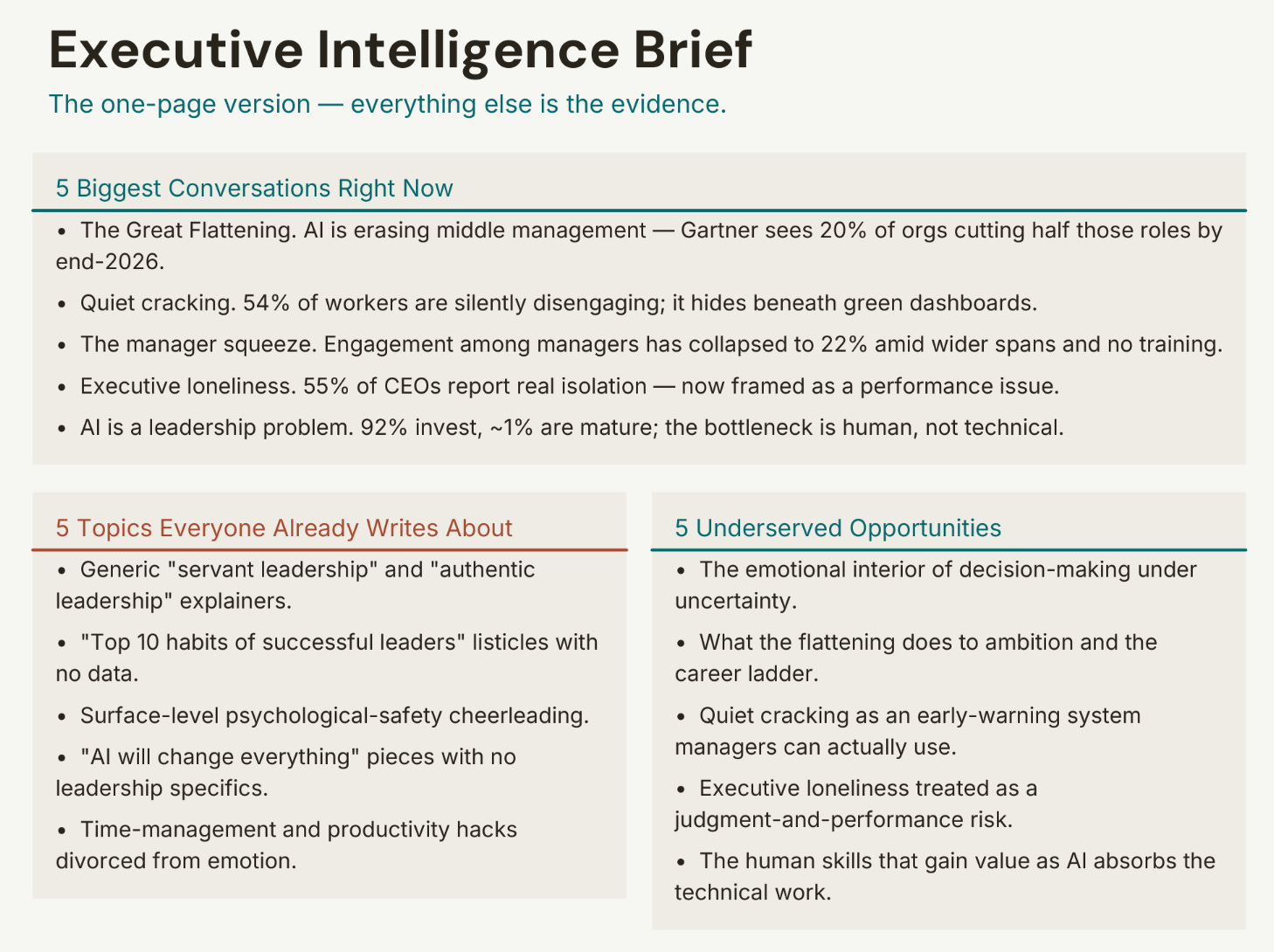
The Great Flattening. Quiet Cracking. Manager Squeeze. Emotional Interior of Decision Making. Do you feel inspired reading that? I certainly did not.
So what did I do? Well, I used another AI tool to see what it would spit back out at me, all while holding out hope that somewhere in something, I would find a thread of usefulness that would miraculously inspire creativity in me.
Instead, I became completely lost in flat words and concepts that meant nothing, and found myself drowning in dry, meaningless information.

Cognitive Load
This is the "I should have known better" section.
Our minds can only process a handful of pieces of information at once in working memory. Cognitive load refers to the amount of mental effort we need to use to process information. When we get flooded with too much information, it can exceed our brain’s processing capacity, and much like a computer, our minds seize up like they’re frozen from having too many tabs open.
Once we get to that point, we’re on a path to struggling to make any decision and dealing with a mental fatigue that starts feeling like mind-fog. Ultimately this also impacts our ability to retain anything. We’ve fried the circuits and roll right into shutdown mode.
I can clearly remember sitting in a psychology lab during my undergrad studies, studying memory and testing each other to see how many numbers we could keep in mind at one time, and all the memory tricks needed to lengthen that string. It was considered about 7 back in the day. And it was bizarrely hard to do.
Here, with the “help” of AI, I had absolutely overwhelmed myself with an outrageous amount of information that was not easily processable, and with no clear signal or criteria to evaluate it. This “useful” report was full of data and trends, but they all felt meh to me. It was information for information’s sake that led me absolutely nowhere.
Could I have made this task better by writing a better prompt? Probably. For sure, the “expert prompt generator” (oh the irony) overengineered a prompt that made this whole exercise bizarrely useless and overwhelming, producing pages of unanchored information.
I didn’t need more information. I needed one idea that meant something to me. A thought that could spur my creativity, and that made me as a human connect with it. Not 100 more facts on the current state of leadership.

The Generation Effect
Looking out for the AI traps, and something that is perhaps even more relevant here is the generation effect (Slamecka & Graf, 1978). Put simply, we understand and retain far more of what we ourselves have created than what we’re handed.
We know this inherently. When we wrestle with an idea, it lands better. We’re able to make more sense of it and find our connection with the material.
The lack of generating our own ideas and thinking is a real risk in the age of AI. If we’re not digesting and interacting with the material, pulling things apart and applying our own reasoning to it, we’re much less likely to actually retain any of it.
I experienced this on my podcast. I would interview authors and discuss the ideas from their books. Like a good podcaster, I would do my research and at least glance through their books (reading everyone is a lot!), and I’ll never forget once asking an author about a model she had discussed in her book that I found quite intriguing.
As I referenced it, I could tell she was completely blank and had no connection to the material whatsoever. I literally had to talk her through the entire model before she could speak to it.
It was clear as day that she had no idea what she had written about. She didn’t “know” her stuff. She had regurgitated a model she obviously never really used from Google or some other knowledge base. It wasn’t hers. She had no real relationship to the material. And because of that, she wasn’t able to make it come to life.
This is the risk we face. We’re moving into an age where we’re drowning in information, but risk starving for real knowledge. Information can’t become meaningful until we’ve metabolized it and made it our own.
The report I got back from Perplexity was pretty, yet utterly meaningless to me because it wasn’t generated by me. It was piles of ungrounded information. So instead of creating, I set myself up for a fishing expedition, glancing through pages and pages of information, trying to find something that hooked me, spoke to my experience, and I could write about meaningfully. Extra, and fully unnecessary “work”.

The alluring shortcut was never a shortcut. Information for information’s sake is not helpful. “Utilizing” AI in this context was merely a distraction that threw me, hook, line, and sinker, into cognitive overload and a disconnected data review. Thinking I was doing something useful led to a literal hours-long diversion
And after all that?
I had to walk away from my computer and the blinking cursor, to do a mind-numbing task for a couple of hours just so I could reset and clear my cluttered thinking, before being able to finally return and sit yet again in front of a blinking cursor, but this time only with my own mind and the need to dig deep.
Finally, I started writing about authenticity and how it went too far at work (which you can read here: Stop Bringing Your Whole Self to Work) . Just me with my raw ideas, needing to be molded into something on a page.
There is no doubt that AI can help us in so many ways. But it can also easily, and sneakily, become an exercise in collecting meaningless information that does nothing more than overwhelm and underdeliver, soaking up our precious energy in the process.
For something to matter to us, and really land, we need to have a hand in it. We have to feel connected to it and be a part of generating it.
Thoughtful leaders need to find this fine line with the AI tools they use. We want to stay connected enough to keep hold of the work, and avoid drowning in meaningless information that does nothing but make the work harder, not easier. That defeats the entire point of what we hope this technology can add to our lives.
Because information overload is not better thinking. It's just more data.

Hi, I’m Kate Snowise - an executive coach, leadership advisor, and speaker. I’m a trained I/O psychologist, bringing together business and psychology in this Substack, Leadership Lately! I write practical thoughts for leaders who want to lead better on a real-life Tuesday, not a theoretical one. I live in the Minneapolis-St. Paul area, with my husband, two boys, and a pack of pups I adore. You can find out more about me and my work at katesnowise.com.
Post thought… I wanted to have a space to make a special mention of the dreaded em-dash. You know, this one —.
This is one of my greatest pet peeves and a total AI “tell” if you ask me! Do you agree? let me know in the comments below.
And the reason I feel like it is such a tell is that who even knows how to do an em-dash?! I had to Google-search it, and it proves my point. Who is actually pressing Option+Shift+Hyphen all at once to get an em-dash in the middle of a sentence just to make their point? No one. AI is.
It personally grates my gears not because I don’t like it, but because I’ve always written with dashes! But now, people probably think my writing is AI-generated because of that?! Ugh. So it goes.
So a note - you will see dashes in my writing. But not the em-dash kind, just the hyphen kind. Which is probably not grammatically correct, and if I write a book one day, I’m sure an editor will fix it. But for now… that is just how I write.
I love this Kate. AI is so tempting when I feel stuck and lacking inspiration and I do fall into the trap of asking it to spit back this seemingly robust and comprehensive answers. Ultimately, I end up feeling less inspired and mentally exhausted. When this happens, I am practicing the work of turning to one of our beloved humans. Still messy at times but so much more deep and enriching. My last adventure into exploring new ways to inspire my writing unexpectedly landed me in my son's creative writing notebook. His quest was to write a poem about "peace" and the prompt was a flower with the word peace at the center and a petal for each of these questions - "what does peace smell like?, what does peace feel like?, what does peace look like?" and so on. It brought me so much joy and activated my creative energy. I'm inspired again.