

Human Sustainability: Setting Ourselves Up for Ongoing Success
Simple considerations on how we can stay in a healthy zone and avoid burnout

I recently had a client change jobs. New organization, bigger role, and a bunch more responsibility.
This coincides with me also contemplating an upcoming two-week vacation back home to New Zealand. I leave on Saturday.
As we were talking through her adjustment to this new role, we discussed the fact that she is in this golden time when she isn’t yet locked into expectations, habits, and ideas that can easily become the handcuffs that keep you trapped in the future.
I realized I was also in this phase here with Leadership Lately. The commitment is new, and the expectations and norms aren’t fully set, either with myself or with you, my reader.
And it got me thinking - this is one of the easiest times you will ever get to consider one simple question that can impact a whole lot.
That question: What is going to be sustainable?

What do I mean by Human Sustainability?
In a workshop I’ve given many times over on human well-being, stress, and how to avoid burnout, I have a slide of a simple burnout continuum.
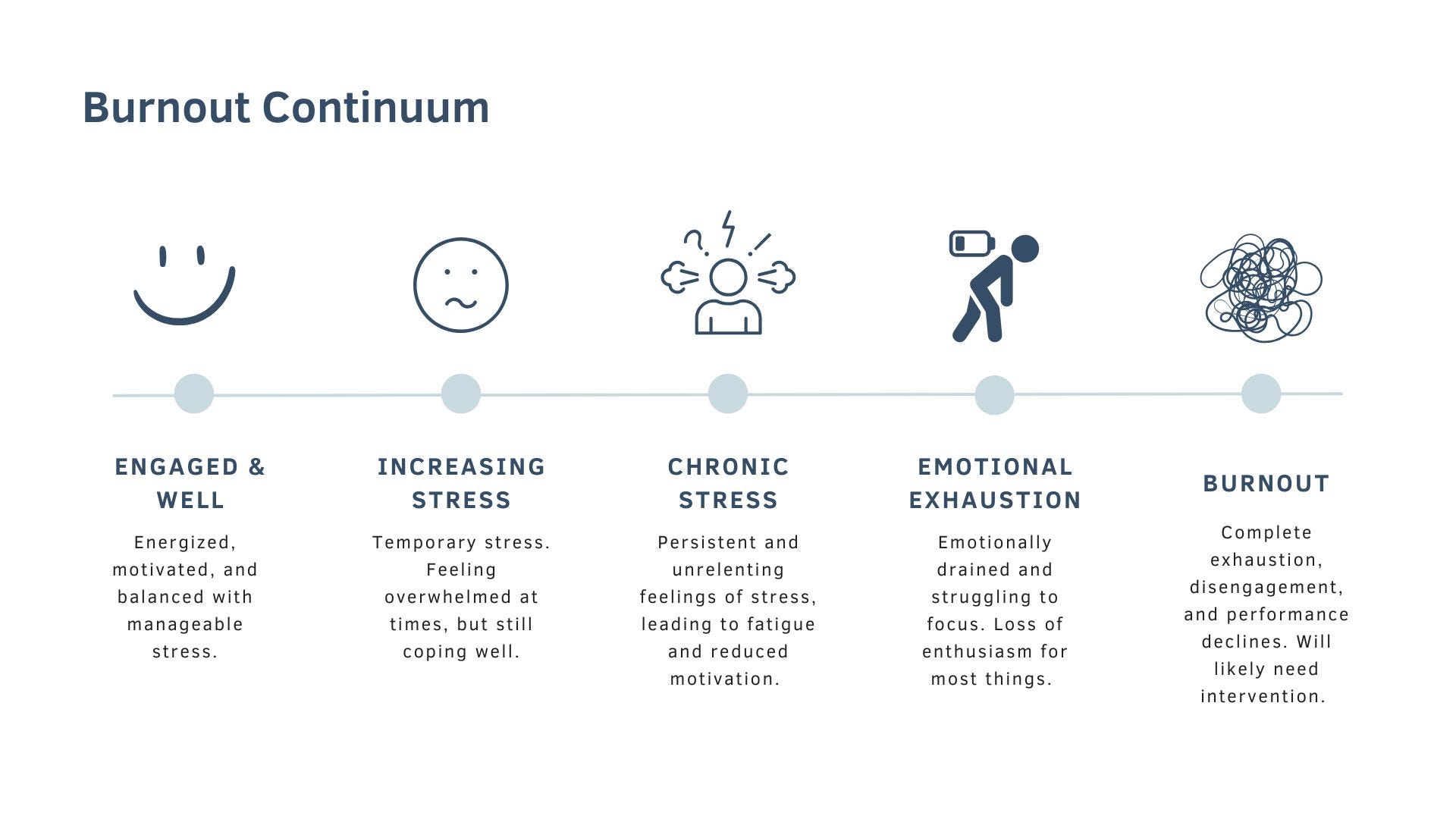
If we’re simply unconsidered and don’t actually think about managing our well-being, we’re prone to running right through any of the warning signs that we’re tiring, and we’ll keep on going, falling further and further down the continuum until the only outcome is burnout.
I often use the analogy of our emotions being like warning lights on the dashboard of our car. If we can check in with how we feel, interpret the signals, and, more importantly, act on them, then we’re much more likely to stay in a healthy zone, which ultimately helps us maintain and sustain our contribution.
We don’t want to wait until the emotional exhaustion phase before we start taking actions that put us back into the engaged and well end of the scale. The aim isn’t to do something amazing once, and then flame out in a blaze of glory.
The aim is to show up well over a long period of time, delivering consistently and feeling good, because you’re functioning in your zone of human sustainability.
Just like any resource, our human energy also has a Goldilocks zone where we need to find the balance of give and take to ensure enough regeneration that we don’t exhaust it completely.

Three Simple Considerations that Make Our Lives Easier
But how do we actually stay in this optimal zone, where we are regenerating our resources (or energy), and not overgiving of ourselves before it is too late?
Here are three simple thoughts I left my client with, and also reminded myself of today, that can help ensure we stay in the zone of sustainable ongoing contribution.


You Teach People How to Treat You
This is one of my favorite personal mantras. We teach people how to treat us.
We are constantly giving people signals about what we will and will not accept. Of course we usually do this completely unconsciously. But through our actions, asks, and boundaries, we teach people what we consider okay and not okay, and what we will and will not tolerate.
This is an essential lesson to learn when we’re talking about building our own sustainable well-being. We are the only ones who can monitor how we’re feeling from the inside, and it is our job to ensure that we push back early (albeit politely) when the asks of us are getting too great.
Don’t resentfully keep pushing through your own boundaries when you can politely hold a line that protects your well-being.
What does this look like at work? Maybe you’d prefer to shut off in your evenings, and want your team to do so too. So simply communicating that you won’t be checking email or Slack after hours, and if someone needs you, they will have to call you, is a simple, clear, and yet kind way of saying - I’m available, but only if you really need me.
That isn’t locking people out or refusing to do your job. It’s putting up a flexible boundary, much like a fence with a gate in it - “You can get to me, and I’m here, but you have one little hurdle in order to reach me.” And it is amazing how many people will check themselves before phoning, but will shoot off a Slack or email without giving it a second thought. Yet both may equally throw you off kilter after work hours.
You teach people what they can expect from you. And if you do this thoughtfully and consciously, you’re much more likely to set healthy limits that allow you to bring your best self to the fore in the longer term (and as a bonus, give others permission to too).

Calm before Chaos
I typically project calm on the outside, but my nervous system is not at all wired to be calm. I’ve been a sensitive soul for as long as I can quite honestly remember. I trigger easily on the inside, and stress and overwhelm most definitely rattle me. In understanding myself, Dr. Elaine Aron’s concept of Highly Sensitive People, or HSPs, really helped me make sense of this.
Along with this sensitivity, when I’m really feeling stretched, I can become a chronically chaotic version of myself. I call it the panic monkey. And if I let the panic monkey into the driving seat of my life, I can have a tendency to jump into a crazed way of attending to whatever is in front of me.
Thankfully, now I realize that frenzied action is never the most efficient or effective way to take care of anything.
Panic spreads panic. And the flip - considered calm spreads thoughtful action.
As part of this, if I can feel a sense of overwhelm increasing, I now recognize this is an invitation to calm my body so that I don’t get caught in an emotionally driven spiral. From there, I can reconnect with my thinking brain (i.e., executive prefrontal cortex) and actually start to thoughtfully attend with a bunch more logic to what is in front of me.
So my personal reminder is to start with calm. It can feel like delaying action in a moment, but 5 min of calming my body through breathing, movement, or writing brings me that much more focus in return.
Get a Plan
I have no idea who said it, but it’s brilliant.
You can do everything, just not all at once.
And there is only so much one human can create, output, or quite honestly do in a period of time. Being realistic about this will make your life infinitely easier in the long run.
I see having a plan much like creating a map through the chaos that is overwhelm and stress so that you can come back to it when you need regrounding. Map the route through before you start walking.
The benefit to this is that it should really start to become clear whether or not there is a path through the maze of obligations. And if it’s completely unrealistic, you can call in help or flag that earlier than the eleventh hour. We can get to everything, just not all at once.
It matters less to me how my clients like to approach their planning and organizing, and more that they simply do plan.
My personal practice isn’t rocket science. A simple glance at the beginning of my week, then I grab a piece of paper and write a list of daily tasks. Ultimately, I consider which one is the highest priority, and work around it from there.
Many tasks end up being transferred to the next day’s list because that reflects a busy person who only has so many resources to give.

Human sustainability may make it sound like we’re a bunch of resources, but I think it is how we need to be thinking about our well-being.
Our energy is not mechanistic. It is a delicate resource that needs to be thoughtfully maintained.
What is going to be sustainable for me is a simple question that, if you ask yourself frequently enough, can gently reorient your commitments and actions toward what actually supports your well-being in the long term.
For my client, maybe that is to thoughtfully consider what job responsibilities she absorbs from the get-go, what really should fit in the role of her team members, what daily planning habits she needs, and how she wants to be communicated with.
And for me, asking that one question led me to decide that with Leadership Lately, if I am on vacation (or holiday in Kiwi-lingo), then writing here is also on hiatus. Because that will allow me to show up well and consistently in the longer term. So you can expect to see me back here in your inbox in just a couple of weeks, post-vacay! Practicing what I preach you might say.
Hi, I’m Kate Snowise - an executive coach, leadership advisor, and speaker. I’m a trained I/O psychologist, bringing together business and psychology in this Substack, Leadership Lately! I write practical thoughts for leaders who want to lead better on a real-life Tuesday, not a theoretical one. I live in the Minneapolis-St. Paul area, with my husband, two boys, and a pack of pups I adore. You can find out more about me and my work at katesnowise.com.