


We’ve all had moments when we’re not our best selves.
Perhaps we got defensive in a meeting because we were caught off guard.
Or we got short with someone after they caught us in the middle of something.
Or we unintentionally brought our funky mood into work and let it follow us into every conversation we had all day.
I recently put together content for one of my Leadership Circles on Self-Leadership, and it had me reflecting again on what it really means to lead ourselves. We often focus on leading others, but how do we lead ourselves well?
A simple morning practice can help us stay in a responsive mindset, and it works so well because of a couple of key emotional intelligence skills.

The Power of Emotional Self-Awareness & Emotional Self-Management
If I’m being honest, recognizing my own emotions didn’t come naturally to me. Growing up in an emotionally restrained family meant that emotions were never a mode of expression that I was familiar with. But I started my coaching career by coaching emotional intelligence, and quickly learned that emotional intelligence wasn’t just responding to the emotions of others and inspiring engagement, connection, and performance - but also being able to recognize and manage one's own.
Emotional self-awareness is a unique subset of knowing ourselves. While one can know what they value, for example, emotional self-awareness requires us to be able to connect with our emotional experience and bring it up into our conscious awareness. When we can do that successfully, we’re able to read our emotions, feelings, and reactions as a form of information in the moment. That is the first skill.
Only once we have strong emotional self-awareness can we move to managing those emotions. Once we can recognize an emotional response, only then can we create space to choose how we want to respond. So emotional self-management isn’t emotional suppression - rather, it is thoughtfully responding to, and expressing emotional data.
A great quote derived from Susan David’s work on emotional agility that echoes this:
“Emotions are data, not directives.”
When we live through that lens, we can recognize our emotional response, and also recognize that “we” - our higher-thinking conscious self - can choose how to respond to that information.

From Reacting to Responding
We’re all human, which means we’re emotional beings. It also means that we’re all going to be prone to our emotions getting the better of us at times.
Think about the moment late in your day when you can recognize that you’re emotionally exhausted and you should really take yourself out of public consumption because you have nothing good left to give. Perhaps you talk yourself out of it because of responsibilities?
Or the moment you recognize that you’re feeling harried because you’re overscheduled with back-to-back meetings. Do you push on through? Or do you politely leave 5 mins early to get a vital breather and reset, so you can bring a refreshed, refocused self into the next setting?
We often don’t give ourselves the permission slip we need to regroup and reset, because our minds give us a million other reasons to push through.
But if we want to be a grounded, calm, and focused leader, opening up that space and giving ourselves a moment to consider our response is one of the most powerful things we can do.
A quote that has stirred me since the start of my career speaks directly to the heart of this skill. It is oft attributed to the great psychiatrist Dr. Viktor Frankl, although it is likely more a summary of his approach and sentiments than a direct quote. You may have seen it floating around:
Between stimulus and response there is a space. In that space lies our power to choose. And in our response lies our growth and our freedom.
Frankl’s sentiment captures the power of being self-aware enough to tune into our natural, human emotions, and then choose our response. This is where we make the crucial break from reactivity to responsiveness.

The Morning Practice
Most of us are running on auto-responding the majority of the time. While this works okay most of the time, most of us know we’re more effective when we’re considered and aware. But there is no doubt that intentionality is harder.
A simple practice that can add so much is a brief morning check-in. As someone who didn’t grow up naming emotions, or being thoughtful in how to respond to them, this is one practice that is essential in keeping me grounded.
The idea is to get yourself in the right headspace every morning and give a few moments of consideration to how you want to show up as a leader in the day right ahead of you.
The “space” that Frankl refers to, usually shows up in the moment when we’re already caught off guard or running on empty. A morning check-in allows us to get into that space ahead of time. It lets us decide, with our thinking, conscious self, how we want to show up. And that forward thinking means we’re much more likely to show up that way later, because we’ve already decided what to do.

It takes less than 5 minutes, but it will set you up to have a more thoughtful, responsive, and considered approach all day.
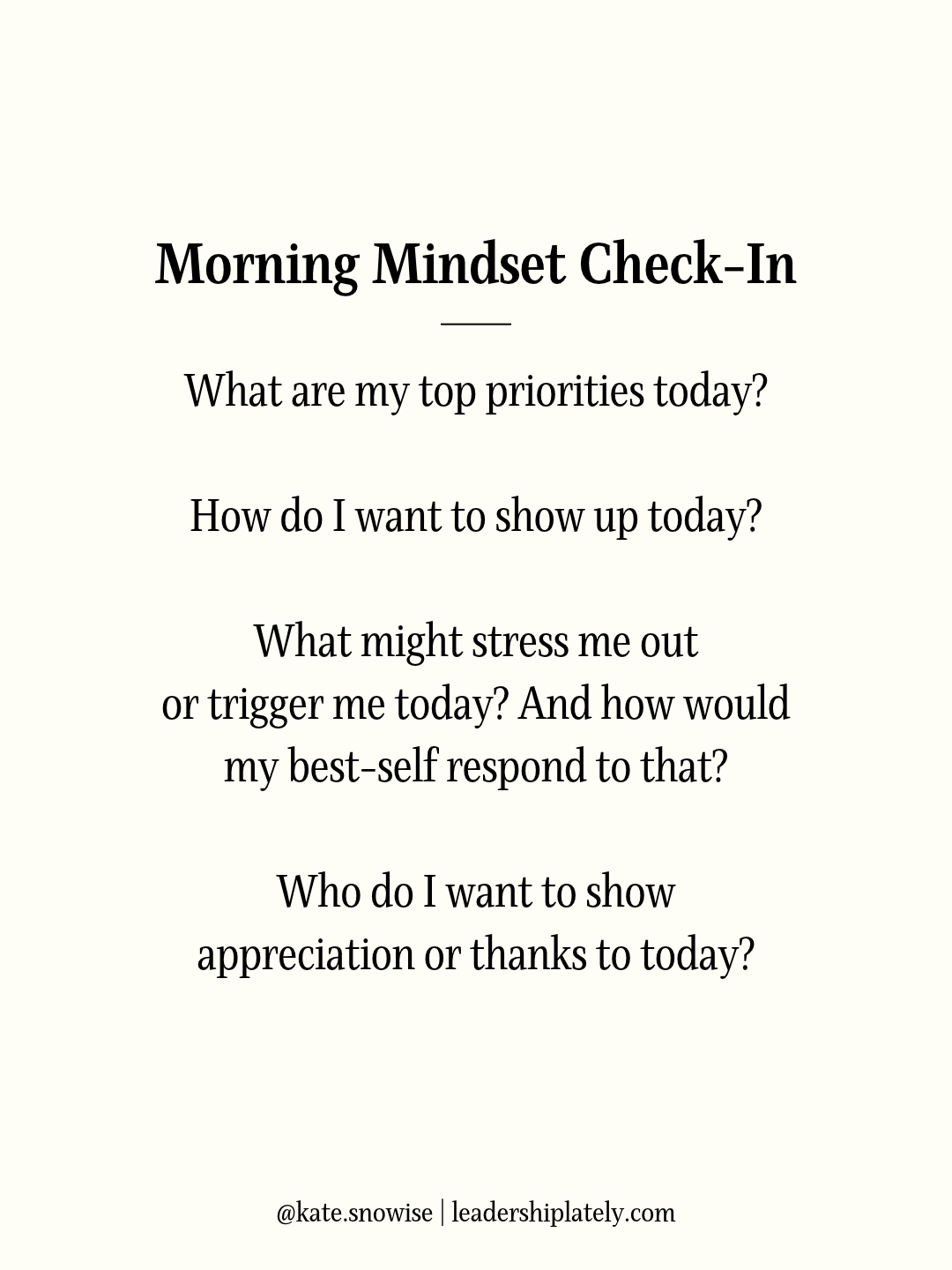
Here are the questions I encourage you to return to every day, before you start responding to the emails and requests:
What are my top priorities today? (Where does my best effort deserve to go?)
How do I want to show up today?
What might stress me out or trigger me today? And how would my best-self respond to that?
Who do I want to show appreciation or thanks to today?

We all think a little practice like this will add monumentally to an already overloaded task list, and I’ve generally seen most people talk themselves out of its usefulness before they’ve ever really given it a go. Old habits and routines die hard.
But the thing with this little morning touchpoint is that the 5 min of consideration it asks of you gives you back a calmer, more considered, and aligned day for the remaining 8+ hours ahead.
Thoughtful moments like this practice help us avoid the rumination that results from reacting emotionally, being short, acting defensively, and having our behavior not fully align with who we want to be. Instead of letting that funky mood follow us into every conversation, with some forethought, we can choose the tone we want to bring forward.
Hi, I’m Kate Snowise - an executive coach, leadership advisor, and speaker. I’m a trained I/O psychologist, bringing together business and psychology in this Substack, Leadership Lately. I write practical thoughts for leaders who want to lead better on a real-life Tuesday, not a theoretical one. I live in the Minneapolis-St. Paul area, with my husband, two boys, and a pack of pups I adore. You can find out more about me and my work at katesnowise.com.