



Recently, I had a client who was struggling to find the right way to approach and motivate a senior direct report he had inherited. This team member, let’s call her Sally, had more years of experience than her leader did and had been in the role before he became the lead. It’s a tricky spot for any leader.
Sensing Sally’s motivation waning, the leader told me about how his solution was to become increasingly more directive and detailed in his oversight of her, as he was concerned she wasn’t “getting it”.
A newer, less experienced team member would likely have appreciated this closer connection and clear direction.
But as my client played out this scenario to me, I started to cringe, knowing full well that Sally's increasing disengagement was likely, in part, being hastened by his now zealous over-involvement - and it sounded like things were going sideways quickly.

Leadership is rarely as simple as a one-size-fits-all solution. It’s a bit like watering plants - the seedling on a windowsill needs a lot more water than your established fiddle-leaf fig.
I know from experience that consistently drenching a fiddle-leaf fig will drown it. It isn’t the care that is the problem; it is the match of that care.
Leading people works the same way. It is complex and nuanced, and it requires a leader to know when to flex, pivot, and adjust… so that the balance of care is just right for that individual.
Last week, I wrote about the difference between being a direct vs. directive leader, advocating for a less directive style as the approach that is likely to foster initiative, agency, and ownership in your team. I absolutely stand by that, but with a caveat.
Some situations actually may call for leaders to be more directive and specific in how things should be done. Like when you have a new team member who doesn’t yet know “how” to do something. Or a team member who lacks confidence and needs to know they’re heading in the right direction.
Sally knew “how” to do this job, and more direction was eroding their relationship further. So what did she need?
A skillful leader is an adaptable leader. While of course they will have an authentic expression and their own signature style, they avoid locking into one approach or a default pattern. Instead, they are mindful enough to step back and consider a situation, and then ask themselves: what is likely the best approach here?

Situational Leadership
A model I often find myself referencing with clients is the Hersey-Blanchard Situational Leadership model.
It’s old-school, but it is a super useful frame that simply posits the best leadership style is the one that fits with the demonstrated level of commitment and competence of the team member you’re leading.
Blanchard most recently popularized the model in Leadership and the One Minute Manager, which I encourage you to read if you want to go deeper. But at a summary level, the four approaches are:
Directing: High directive, lower support. For use when a team member has high commitment but lower competence (likely due to inexperience or being newer in a role).
Coaching: High directive, high support. For use when a team member has increasing competence, but commitment may be starting to fall (often due to the Dunning-Kruger effect, where our confidence often drops once we realize all we don’t yet know).
Supporting: Low directive, high support. For use when commitment is variable, and competence is moderate to high.
Delegating: Low support, low directive. The perfect match for a team member who is highly competent and self-motivated. Leave them to do their thing.
To access the direct link and an overview of the Blanchard SLII training model where this image came from, head here > https://www.blanchard.com/our-content/programs/slii
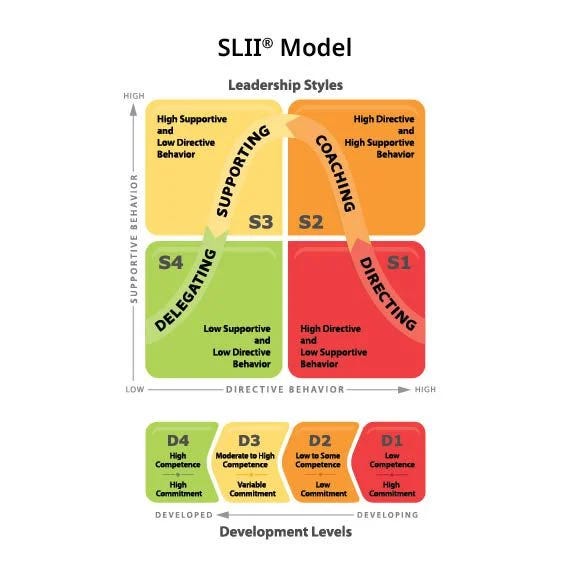

I talked this through with my client, and he immediately appreciated that his approach probably wasn't driving them closer towards the outcome he ultimately wanted.
On the Situational Leadership map, Sally was in the Delegating quadrant on most days. Her competence was never in question, but my client perceived wavering commitment. This may have pushed her into the Supporting square (rather than the Coaching bucket, which would have been more directive).
What she was receiving, however, was a Directing approach. It likely would have been the perfect match for her 15 years earlier, when she was in the beginning stages of her career and role… but it was a complete mismatch, and breeding disengagement from the level she was at now.
The fix here for my client wasn’t complicated. It was about backing off the close monitoring, avoiding getting down in the weeds with her (or up in her kitchen), and upping his connection and encouragement. He needed to give her the room to do the work she already knew how to do. This model highlighted that.

Every leader I coach has a team that they could plot across this entire map. That is the point. Your support person two years out of school needs something very different from your individual contributor with two decades of experience. A single style or approach isn’t going to serve them both.
Once you have the frame, the check becomes simple. The one question to ask yourself before your next one-on-one is: based on what I know about this person, how much direction and support would likely bring out the best in them?
Or more simply: how much water does this plant actually need?
Hi, I’m Kate Snowise - an executive coach, leadership advisor, and speaker. I’m a trained I/O psychologist, bringing together business and psychology in this Substack, Leadership Lately. I write practical thoughts for leaders who want to lead better on a real-life Tuesday, not a theoretical one. I live in the Minneapolis-St. Paul area, with my husband, two boys, and a pack of pups I adore. You can find out more about me and my work at katesnowise.com.